Haijme no Ippo is one of my favourite anime (and TV shows) of all time, and it’s a boxing anime.
One of the main characters, Ichiro Miyata, is the son of a world-class boxer whose career ended suddenly one day, during a fight that he was supposedly dominating.
Ichiro says that his father’s opponent, who was physically stronger but technically much inferior, just landed a lucky punch out of nowhere.
But the Miyata Sr. countered back:
In boxing, there is no such thing as a lucky punch.
Any real punch has some force behind it, which means that the person who threw it was still in the fight.
That person had not given up on winning yet.
A weak ass punch from a fighter who has already “quit” could never knock out a world class boxer.
I think this is one of the most life-changing dialogues I’ve ever seen in any work of fiction.
How much of success in life depends on simply staying in the fight? Whether it’s business, or sport, or relationships / marriage, or anything like that?
How many people have made breakthroughs by simply sticking it out and doing the work beyond the point that most people consider a “lost cause” — and then being told someday that they got lucky?
This week and this day is the template for the entire decade.
Think about what you’d want this decade to mean in the context of your entire life story, and then look at how you’re spending your time and energy.
The time you waste today,
The energy and health you’ll lose on toxic people and destructive habits this week,
The opportunities you procrastinate on AGAIN to do the things you should (even telling your loved ones that you love them)
…will repeat themselves like a pattern and dirty the end result of this entire decade unless you FORCE significant effort into overcoming this inertia and change what you do today.
As I’ve gotten older, I’ve realised that despite the many things outside our control, we still mostly write the story of our own lives. We’re unconsciously shaping our story every day, just by the way we choose to spend our time.
Days and weeks become decades. Decades are made up of days and weeks.
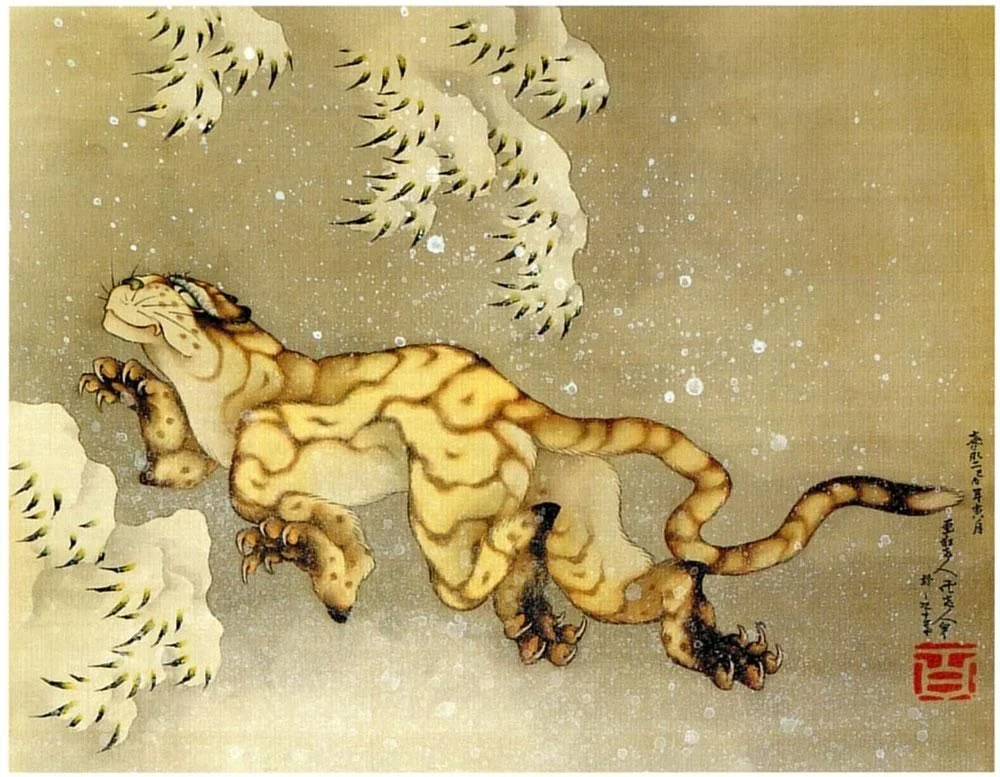
Hokusai; Tiger in the Snow (painted in 1849, the last year of his life)
I was talking to a former teammate today and he told me that he’s “trying to get good at storytelling” because it doesn’t come naturally to him.
I told him it was a huge mistake to think that way. “Never try to get good at something you’re not talented in.“
Trying to “get good” at something, in my opinion, is in fact downright dangerous.
When you try to “get good” at something, you’re inadvertently buying into several destructive beliefs:
That you are “bad” at the thing compared to others
That you have to “reach” some kind of advanced level of proficiency (which you vaguely describe as “good” or “no longer bad”)
That you will “suck” at it for an indefinite period of time
This is way too much pressure to actually make any kind of meaningful progress.
Counter-intuitively, by following the above advice, you can become world-class at that very thing, sometimes outclassing even those who are talented at it.
And that brings us to today’s topic: the Basics.
I’ve learned that it’s way better to reframe your perspective to this instead:
“I’m not talented at this. I shall give up on being good at it. Hence, I will only learn the bare basics — and then simply practice those basics endlessly until the end of my life.“
In any domain you can think of — whether it’s mechanical engineering, music, public speaking, marriage, sex, basketball, or customer service — there is always a list of “basics” or “fundamentals.”
The key quality of basics is that anyone can learn them, practice them, and become great at them. And therein lies the deceptive power.
I’m a firm believer that simply by mastering the basics, you can do better than most of the so-called “experts” and “advanced practitioners” in any domain you can think of.
Or like Hokusai (the great Japanese artist) whose quote went like this:
…until the age of 70, nothing I drew was worthy of notice. At 73 years I was somewhat able to fathom the growth of plants and trees, and the structure of birds, animals, insects and fish. Thus when I reach 80 years, I hope to have made increasing progress, and at 90 to see further into the underlying principles of things, so that at 100 years I will have achieved a divine state in my art, and at 110, every dot and every stroke will be as though alive. Those of you who live long enough, bear witness that these words of mine are not false.
So I’ve personally given up on ever getting “good” at anything.
Here are some things that I’m not good at, where I’ve managed to come FAR by simply learning the basics:
Judo (struggled to get “good” for 3 years; suddenly had a breakthrough when I refocused on the fundamentals)
Interpersonal relationships (the first few chapters of ‘How to Win Friends and Influence People’ by Dale Carnegie are alone enough for a lifetime of success)
Have you ever stopped to acknowledge that people remember decades in the next century?
Eg: The “Roaring 20s,” the “Depressed 30s,” the “WW2 and post-war” 1940s, the “Recovery / Baby Boomer 50s,” the “Crazy 60s,” and so on.
Well, it’s now 2025 (damn), and we’re in the middle of the “20s” decade of this century.
So far in this decade, we’ve seen Covid-19 and global shutdowns, then the recovery from that, and now the rise of AI. Whether this decade will be defined by Covid or by AI, I’m not yet sure.
But for YOU (and ME), this decade will be defined by “what were you doing at that time?“
And that is a scary question to answer.
For me, so far, the 20s have seen the beginning (or you could say, the starting phase) of my journey as an entrepreneur and leader, the beginning of my 30s, my globetrotting from the USA to India and then to Japan (with a quick stop in Europe in between), and also the beginning of my self-imposed challenge to carve a place for myself on the global stage, and in this era.
That’s already a lot.
Interestingly, none of the things I actually did — such the exact businesses I started, the book I wrote or podcasts I hosted, nor any of the major events in my life — feel “noteworthy” right now, as I look at the big picture. Any and all my accomplishments / milestones feel like a footnote, a detail.
After all, we’re talking about “phases” here — the things under the surface that will eventually come to define this period of your life.
Coming back to 2025, I believe I have a decent answer to that question (“what were you doing in that decade?”). It is both a theme, a mission, a goal, and an affirmation of sorts. Thankfully, we’re only half-way in, so I still have time to live up to it:
In the 2020s, I was trying to become a legend.
I’ve always been curious about what motivates me, and which things I feel the most proud of. And I realized that the achievements that make me proudest are those that have a certain “competitive” or “distinguishing” angle to them.
In college, the only accomplishments I remember fondly are those where I distinguished myself out of everyone else — such as that one Physics end-term exam where I solved two problems that nobody did (and became the only person to get an A in that class out of 250+ kids), or that I was the first person to start taking online courses on the side, and some of the things I did in China.
Same thing after college — I only remember the things that distinguished me from either my peers or my contemporaries — doing the things that nobody else did, or nobody else did better.
I have recognized this desire to distinguish as one of the primary drivers of my life.
I’ve always wanted to be legendary at whatever I set my mind to do — or you could say, the desire to be legendary IS what set my mind to do things.
I’m a very lazy, distracted, and time-wasting guy by default. You would never believe by looking at some of my habits and natural inclinations that I would ever be a winner. I can binge watch anime or movies until the cows come home, and I can sleep until the sun gets tired of shining.
But on the flip side, I have a side that’s also more disciplined, more intense, and more ferocious than anyone. And the only thing that turns on that “switch in my head” is the decision to be legendary.
At SANPRAM, I want to surround myself with people who want to become legends in their own right, at whatever they do. The company itself wants to become legendary — I want us to eclipse the influence that SONY had back in the 70s and 80s.
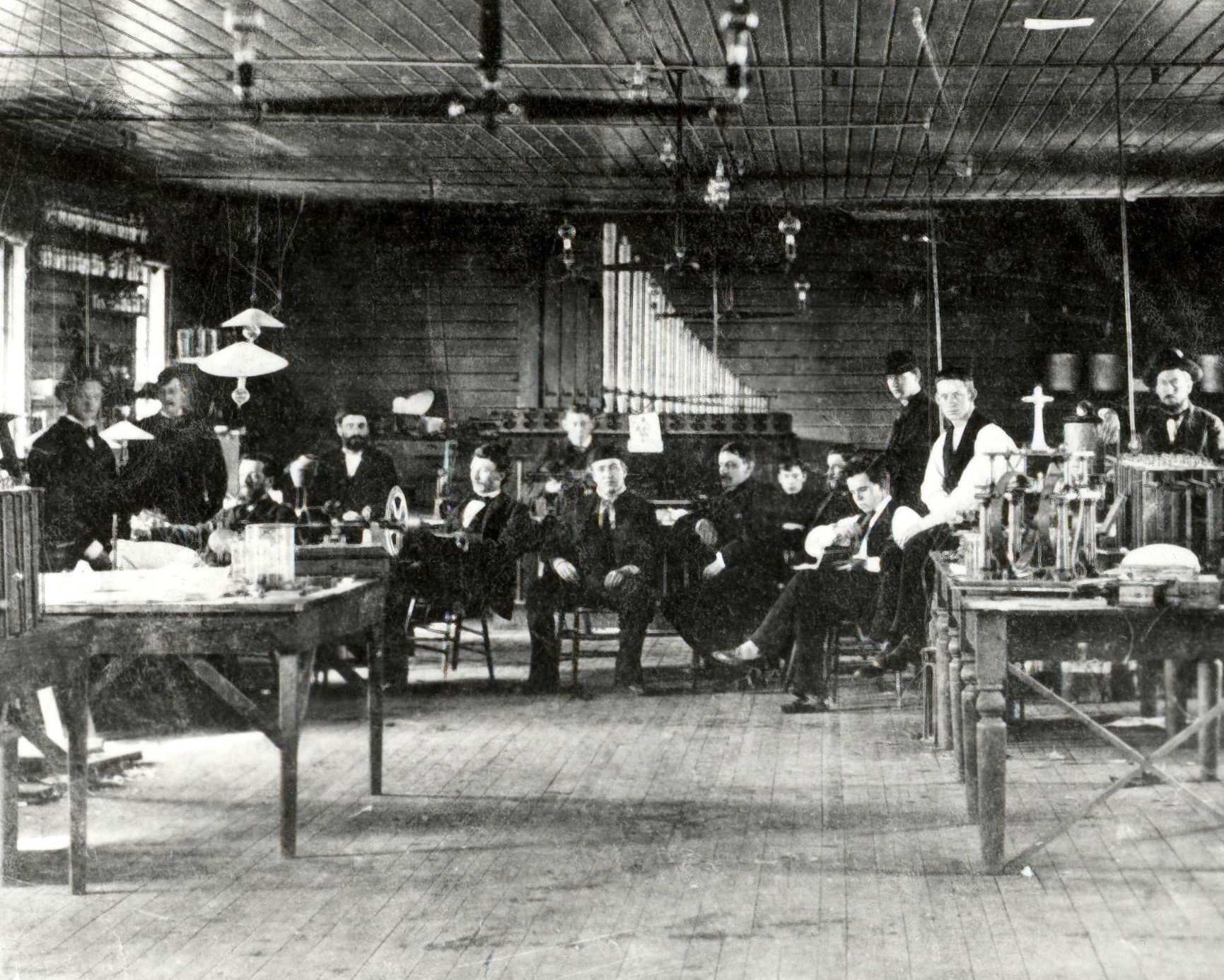
Let’s build a 21st century organization and an environment where it’s a mandatory requirement to do legendary things. Just like Edison built the world’s first applied research company at Menlo Park, my goal is to build a “legend factory” unlike anything ever seen before.
I recently spoke to someone who was part of Robert Maxwell‘s original gang at Pergamon Press.
Spent ~50 years in the publishing business — a journal mafia veteran and founding member, so to speak.
I thought he might have been reformed, and even if not, maybe I could learn something from him. Because after all, we have to do a lot of things that Maxwell had to do in his heyday.
Turns out, he believes that the science publishing industry is great, that Nature and Elsevier and all these magazines are doing good for the world, and that there’s no reason to disrupt what he thinks is a beautiful system.
“Charging so much money isn’t a big deal because universities had the budgets anyway.”
When I mentioned that less-endowed universities in “developing” regions like India don’t have that money and therefore can’t access the science, here’s what he had to say:
“Indian universities would have more money left over if they weren’t lining up the pockets of politicians.”
Say what you want to that argument (even if it were true).
Another notable opinion:
“Do you know how much Elsevier spent on building the ScienceDirect website in 1997? $150 MILLION. It might be bonkers today, but any judgments about them should be made while keeping that in perspective.”
(As if ScienceDirect is a non-profit charity project)
Many other such moments of brilliance later, it culminated in him telling me over email that I should “recognise that I won’t be a disrupter,” and that if I want to do something useful, I should be building software for Elsevier as my customer to make their business more efficient or something.
And he was not polite when he said it.
Now look, as an entrepreneur I’m used to rejection and skepticism — I have a permanent bedroom-sharing relationship with both of these things.
But this time it felt different. It wasn’t scepticism, it was Goliath trying to stare down David and telling him to stay in his lane.
When I read that email, I was a little pissed, but I wasn’t upset — I had a powerful negative energy brewing within me. I sat back and allowed myself to soak in that energy.
I’m done with the guy. In fact, I’m done with the whole pack of people who work for or support the big science publishers. I’m done giving them any benefit of doubt, to be reasonable, to keep an open mind.
But I’ve decided to not get “over” this episode. The negative energy is too powerful, and an addictive source of strength and focus.
The monarchs of the Joseon dynasty (Korea) are believed to have had a certain very simple and effective policy for centuries, which went something like this:
“Rule your subjects with forgiveness. Rule barbarians with the sword.”
As a cosmopolitan Indian, to me, Japan’s most striking feature is this:
Blue collar work ethic, combined with white collar pride in their work.
The Japanese are “Pro” at whatever they do.
You’ll see a woman security guard or police officer standing at attention for hours, even in the quietest of neighborhoods.
She will not lean against the wall, or look around for distractions. Being at attention is her work.
She is dressed sharp and keeps a stoic face (even though she’ll happily return a pleasant smile if you say お疲れ様).
The Japanese cashier at IKEA will not check his phone when there are no customers waiting in line.
You see the same attitude in a Starbucks barista, an usherer, a garbage collection worker, or an engineer or investment banker.
How much of this is healthy vs unhealthy, natural vs forced, etc is immaterial.
What matters in the end is that it has made a big impression — not just on me, but on the whole world, for many years — and it doesn’t cost anything.
What I’d love to see more of in Japan today is ambition. There seems to be a pervasive sense of “life is good, we have enough.”
There is a shortage of leaders (like founders of Sony, Uniqlo, or Softbank) who want to conquer uncharted waters.
But with SO many people with an exceptional work ethic and the ability to take pride in their work, who want to be led, there is a HUGE opportunity for young leaders who have creative ideas and a killer mindset.
It would be really hard to compete with a Japanese leader who has a big vision and the mindset needed for running through walls.
For foreigners especially: there are barriers of language and culture, but if you can bridge them somehow, you could build some incredible companies in Japan.
But I’m also open to believing in many things that are supposedly supernatural / pseudoscience / woo-woo.
Eg: visualization / manifestation, certain yogic practices, Ayurveda and other ancient Indian concepts.
To me, this isn’t a contradiction at all.
To be a scientist means to be a lifelong heretic.
1. Question information that doesn’t align with your understanding.
2. Question your understanding when it doesn’t align with observations.
3. Test things for yourself as much as possible.
(Isaac Newton studied alchemy and the occult for 30+ years — it’s unlikely that him and thousands of other scholars throughout history would stick to it for so long if it was BS and they didn’t make any progress.)
What you do NOT say:
“This is incorrect because Wikipedia says so / my school textbooks said so / there are no studies to confirm this.”
Such statements are intellectually dishonest in nature.
Being close-minded and surrendering your beliefs to authority — even the “scientific authority” of your current times — isn’t scientific.
Eg: some people believe that Covid was a hoax. Now, MY experience tells me that in India, during the second wave:
Hospitals around the country ran out of oxygen cylinders.
Cremation grounds in Delhi were so full that people had to be cremated on the streets
Even firewood for cremation became extremely hard to find — you had to go procure your own.
I don’t know a single person who didn’t lose any family member to the virus within that short span of time.
Some of my friends who did catch Covid, said that it was the sickest they’d ever been.
Since each of these occurences are statistically significant (i.e. they almost NEVER happen) and there is a strong causation in play, I believe that Covid was as real as the earth under my feet. “It’s just the flu” doesn’t explain my observations and evidence, so the statement is untrue in my book.
At DenseLayers, we’re taking on some interesting problems.
The first one, which you are already aware of, is to accelerate frontier sciences.
The second one is to build something that will live for at least a thousand years.
In fact, most of the value of DenseLayers will be realized centuries into the future. All we’re doing as the founders is to stand up a few dominos, kick the first few, and nominate other people to place larger and larger dominos in the front, and continue to pass the baton through generations.
Our mission is to make DenseLayers into a train that travels eternally in the right direction. It’s fine that as mortals, we will never see most of the destinations it visits. Such is life.
In fact, if you join DenseLayers, the stocks aren’t to make us rich, they’re to make our grandchildrenricher. The joy of the journey and eternal glory is for us.
The challenge.
Now, it has come to my attention that building a thousand year company may not be very easy.
So let’s sit down and figure out what needs to happen for this train to keep rolling for a millennium.
Let’s start with defining the basic problem here, such that even a 5th grader could understand.
There are many conditions that, if met, would cause an organization to live for 1,000 years.
But there is only one condition that can ensure it:
If the organization dies along the way, it regenerates and continues with its original directive.
The other condition would of course be that it never dies in the first place. We’ll get to that later.
As a systems engineer with a background in failure-tolerance, I prefer to assume that the worst WILL happen, and simply build for the ability to recover.
With that, let’s reframe the challenge:
Do everything we can to increase the odds of regeneration, as well as the odds that the original directive will be followed.
In other words, build a company that can keep showing up and live to fight another day.
This framing gives us a lot more room to play with, and a lot more room for mistakes. We no longer have to rely on a silver bullet for longevity, but rather devise a myriad of fail-safe measures that we can “stack” on top of each other.
It’s a classic engineering problem. You simply design a system for resilience and recovery above all.
As a trained systems engineer, and also a former safety engineer for self-driving trucks (in charge of functional safety and designing fail-safe protocols etc), it’s as if this is what I’ve been preparing my whole life for.
Brainstorm
First, let us look at certain organizations that have already cracked the code on longevity:
Universities
Family-run businesses
Religions
Countries / Kingdoms.
…and so on.
By studying what’s already worked in the past, and combining it with new technology, we can craft a realistic, compelling plan for ourselves.
Here are some examples of features (or bugs) we can build:
A clear directive that can be followed for eternity, regardless of how the human species and our culture evolves over time. (“Accelerate frontier scientific research”)
Make it so the data/information contained in DenseLayers is incredibly hard to destroy; as long as a single copy remains, it can respawn the entire network. (Blockchains? Distributed database?)
We have a system for recruiting people that continues to attract people to the cause. (Content marketing / Books / Referrals)
Even if the number of members dwindles to zero, a new individual can join and both get and create value. (YouTube)
If the company fails in one country, it still has roots elsewhere. (PirateBay? Yahoo Japan?)
The company allows disruptive innovation from within. If someone comes up with a technology that makes the current tools obsolete, the company must pave the way for new methods to be successful. (Eg: 3M, Nintendo)
The company’s funds don’t run out — i.e. do not depend on a single source of revenue, always save a portion of income and invest it elsewhere such that the principle remains unharmed and also earns a regular interest. (Universities)
There is a robust system for succession. (Nobel Prize committee? University Leaderships? Democracies?)
Members need as few resources to join and benefit as possible — even the remotest humans can plug into the scientific network with primitive devices. (Facebook?)
…and so on.
On the other hand, we can also do things to reduce the risk of death in the first place. In that respect, I have a simple philosophy:
Always offer the best deal that your customers could find in the market.
I often look at the Japanese industry for examples galore. Kawasaki, Toyota, Honda, Nintendo (one of my faves), Sony, Panasonic, and so on.
In the west, you have companies like Disney and Apple.
What I love about the bolded ones above, is that they tried to diversify (not betting the future on a single product), while still being focused on a single purpose.
They were also product-leaders: we keep buying from them mostly because they make really good shit. They even inspire other companies to step up their quality.
An example I love is that Nintendo, after their Game Boy was a massive hit for 11 years, lost dominance to Sony’s Playstation, then made a comeback with the Nintendo DS, and later again made a huge hit with the Nintendo Switch. And this company was founded in the 1880s, with paper card games!
I also like Apple’s example — even though I don’t think much of the new iPhones, the Apple Watch and AirPods (launched after Jobs died) are each multi-billion dollar businesses in their own right. You gotta give the team credit.
I want DenseLayers to similarly keep building amazing tools for scientists and innovators of all ages, forever, and always offer the best wares in the market. The goodest shit, always. If we can build a culture where offering the best products for scholars is more important than anything else, then we should be good to go.
***
Here’s a thought I had this afternoon, after a bathroom break while walking back to my desk:
Imagine if (after we’re successful) we plant hundreds of time capsules all over the world, with each capsule containing instructions for how to regenerate DenseLayers (the scientific network), rebuild it to success, and once again plant new time capsules that last a century or two.
We could design the content of the capsule such that it becomes the talk of the town, and also makes a pretty compelling case — enough to inspire one crazy person to take the idea and run with it (which is all we need really).
The most valuable trait or habit that I’ve developed as an engineer is to “focus on the problem, not the solution.”
Sounds very counter-intuitive. Don’t we usually say the opposite?
The context here is that most people love to complain about problems and then hasten to slap solutions, as opposed to STUDYING problems and trying to investigate why they’re there in the first place — and solving the root cause.
Most engineers are guilty of this. They love to rush to coding as soon as they see a requirement, as if they’ve been bit by a rabid dog and can’t keep their hands still.
The product you end up with is a “well-made piece of crap.”
The best engineers I’ve ever worked with, and those I’ve read about in history, are more interested in solving the problem than in finding a solution.
Yes, there is a big difference between the two. You’re focusing on the right solution, not the first solution that came to mind.
The first approach takes a bit of investigation, thinking, and study — which takes humility that you don’t know everything — and also involves a time delay before you can get to implementation.
The second approach gets you going quickly, but in the long run, you end up having to throw away and redo too much work, writing off huge losses in both time and money.
Now, it’s not like you can’t succeed with “move fast and break things”; I may be wrong, but I’ve heard that companies like Facebook and Angellist famously cultivated and encouraged this kind of culture.
Unfortunately, most companies can’t afford to do so. And they don’t need to — there’s a better way, a best of both worlds.
The key to the conundrum is how well-defined the boundary conditions are.
“Let’s hack something” is a great next step for situations where the problem is quite simple or trivial, and the boundary conditions are clear.
But as soon as you come to a systems problem (such as a UX problem where even a human is involved), then you have to think about what the solution can and cannot do, which quickly eliminates many default solutions that you may have implemented in the past.
In systems engineering, we usually suggest 15% of the project timeline being spent up front on this, with the rest spent on implementation / hacking.
Or rather, I’d say there are plenty of people driving lamborghinis and flying private and consistently sitting on the front pages of newspapers whom people could listen to.
I remember flipping through a book by T Scott Gross, the author of “Positively Outrageous Service” as a kid (saw it at a bookstore and it got my attention), and it really blew my mind. Since then I’ve wanted to offer positively outrageous service in every business I do, both at the product level and the service level.
At my company, we do follow some “outrageous” business practices that I was reflecting on today.
1. Our products and services aren’t good or better or even “best” — they’re groundbreaking.
I’m not saying this for shits and giggles. In my career as an entrepreneur so far, I’ve only made and offered things that have either never existed before, or are on a completely different level than anything else on offer.
If it’s not 10 times better than whatever already is, I don’t do it.
The first project: the “Tech Fluent CEO” program, later made into a book. Yes, I realized later that other such products exist. But none of them accomplish anything remotely close to what mine does.
The same goes for both my podcasts — the content is both 10x better and unique.
It often makes it hard to market and explain what I do, and questions like “is there a market for this?” and “how does it work?” are constantly coming up.
Look, I was inspired by SONY when I was 19. In Akio Morita’s book “Made in Japan,” he said that Sony always wanted to look to the future, and build products that would shape the world as they saw it. Every product that Sony brought out, started as a dream — not a number on a spreadsheet.
I have the utmost respect for people who build businesses based on what people are already looking for and lots of demand analysis, but that’s not how my brain works. I’m in the innovation business. I’m in the future business.
We skate to where the puck is going to be, not where the puck is right now.
2. I don’t offer 30-day or even 90-day guarantees. I offer a lifetime guarantee.
Back when I was offering the tech fluency program, the first ever person who signed up (and paid full price upfront), got busy with other projects midway through the course. He never came back.
I tried to contact him over time, to come back, but he couldn’t.
Finally, 4 years later (long after I stopped doing 1-1 coaching and was doing a different business), I emailed him again, saying that he’s always welcome to come back and finish what he started. This time, he did reply, and we will continue our relationship.
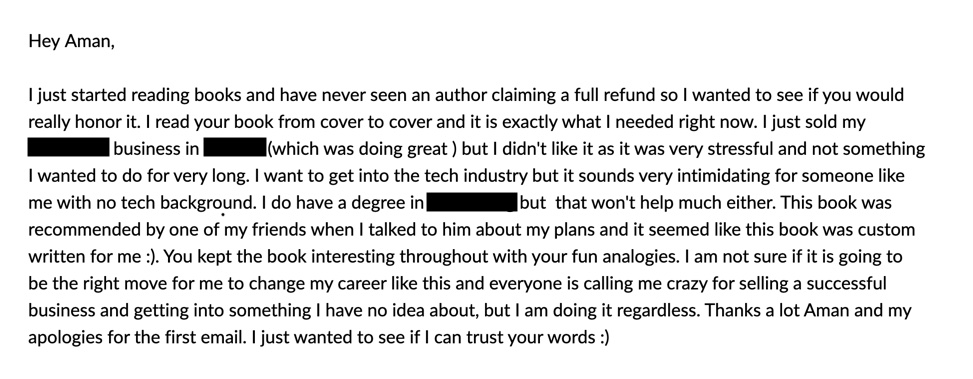
On the first page of my book, I say clearly — if you buy the book and realize that you aren’t the right reader for it, you get your money back, no questions asked. There’s no timeline.
50 years later, if you said, “you know, that book I read in my 20s wasn’t really worth my money” – I’d still like to give you a refund.
One reader actually tried to test this, because he couldn’t believe this was true. But I obliged, and this is what he said:
However, I must mention that recently I felt “whooped” by Andy Frisella’s company 1st Phorm, because they offer a 110% guarantee on their products. So we will start offering a 120% guarantee as soon as we are able to.
But hey — I did offer a guarantee on my podcasts too from the beginning – if you find another podcast that covers a topic better than we did, I will give you $20. Andy doesn’t. (Score: 1-1)
The next phase
While the above things are apparent in hindsight, I wasn’t even consciously aware of them when I was actually doing them.
But it’s clear to me that this philosophy needs to be at the center of the entire business; its energy permeating not just the product and service, but everything from marketing, to branding, to operations, to vendor relationships, employee relations, and so on.
Offering a positively outrageous experience to every person along the chain, makes for an indestructible business. And I want to build a company where this is in the very DNA.
I challenged myself to get a black belt in Judo in 12 months, training at the Kodokan in Tokyo.
I challenged myself to achieve fluency in Japanese in 12 months. The result blew me away.